Strix aluco - The Tawny Owl
Strix aluco - The Tawny Owl
From the Captain's Avian Studies - Where Ornithology Meets the Open Sea
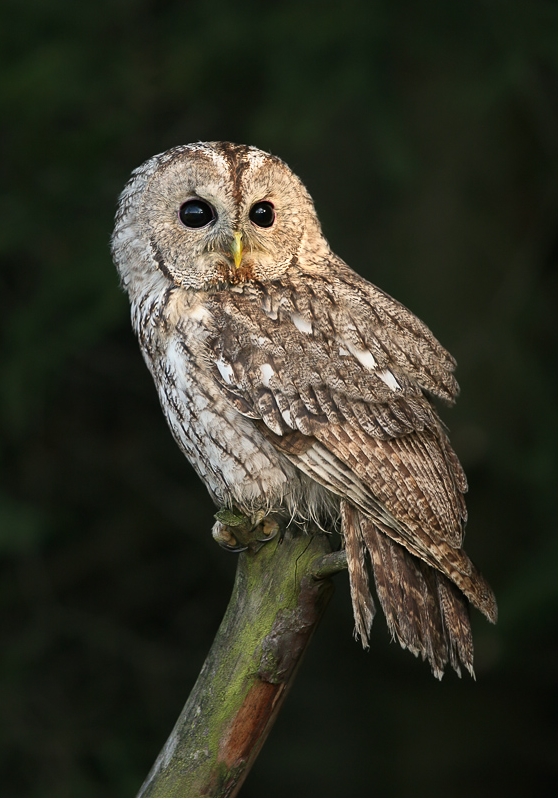
Tawny Owl (Strix aluco) showing characteristic facial disk and dark eyes. Image: Wikimedia Commons, CC BY-SA 3.0
---
Vocalizations
The Tawny Owl possesses one of the most iconic calls in all of ornithology - the "tu-whit tu-whoo" immortalized by Shakespeare. However, as ornithologists have discovered, this famous phrase conceals a fascinating secret: it is not one owl, but two.
The Truth Behind "Tu-Whit Tu-Whoo"
The "tu-whit" (more accurately rendered as "ke-wick") is the female's contact call, while the "tu-whoo" (properly "hoo-hoo-oooo") is the male's territorial hoot. When Shakespeare wrote in "Love's Labour's Lost" - "Then nightly sings the staring owl, Tu-whit; Tu-who, a merry note" - he was unknowingly documenting a duet between mates, not a single bird.
Featured Recordings from XenoCanto
Male Territorial Hoot:
Recording by Jacobo Ramil Millarengo - Classic male hooting call
Duet (Male and Female):
Recording by Bartholomäus Dedersen - The legendary "tu-whit tu-whoo" duet
Female Contact Call (Ke-wick):
Recording by Mark Plummer - Female contact call
Alarm and Agitation Calls:
Recording by Mark Plummer - Alarm vocalizations
Atmospheric Night Recording:
Recording by Rafael Campos - Nocturnal woodland atmosphere with Tawny Owl
Browse all 3,800+ Tawny Owl recordings on XenoCanto →
---
The Scientific Account
Taxonomy and Distribution
Scientific Name: Strix aluco (Linnaeus, 1758)
Common Names: Tawny Owl, Brown Owl
Family: Strigidae (True Owls)
Order: Strigiformes
The binomial derives from the Greek strix ("owl") and Italian allocco ("tawny owl"), which itself comes from the Latin ulucus ("screech-owl"). The species was described by Carl Linnaeus in the tenth edition of his Systema Naturae in 1758.
The Tawny Owl is distributed across much of the Western Palearctic, from the Iberian Peninsula and British Isles eastward through Europe to western Siberia, and south to the Mediterranean, Turkey, Iran, and the Himalayas. Seven subspecies are currently recognized.
Physical Characteristics
- Size: 37-43 cm in length; wingspan 81-96 cm
- Weight: Males 330-475 g; Females 385-600 g
- Plumage: Highly variable - rufous (brown-red) or grey morphs; heavily streaked underparts
- Facial Disk: Large, rounded, with distinctive dark eye borders
- Eyes: Large, dark brown to black (unlike the yellow eyes of many owl species)
- Sexual Dimorphism: Females significantly larger; otherwise similar in plumage
- Flight: Silent due to specialized feather structure with soft, comb-like edges
Sensory Capabilities
The Tawny Owl possesses extraordinary sensory adaptations for nocturnal hunting:
Vision
- Eyes adapted for low-light conditions with high rod density in retina- Binocular vision provides excellent depth perception for striking prey
- Can detect movement in light levels 100 times lower than human threshold
Hearing
- Asymmetrical ear placement allows three-dimensional sound localization- Can pinpoint prey location by sound alone in complete darkness
- Facial disk functions as a parabolic reflector, concentrating sound to ears
Behavioral Ecology
Vocalization Research
Recent research (E3S Web of Conferences, 2024) on vocal interactions between Tawny Owls and Ural Owls (Strix uralensis) has revealed:
- Temporal Patterns: Co-vocalization between species occurs primarily in spring during breeding season
- Peak Activity: Calls recorded 2.5 hours after sunset, with peak co-vocalization between 21:00-22:00
- Call Frequency: During co-vocalization periods, Tawny Owls produce twice as many calls as Ural Owls
- Initiation Patterns: Tawny Owls typically begin calling first, with other species responding
Territorial Behavior
Tawny Owls are highly territorial and maintain their territories year-round:
- Territories defended through vocal displays and direct confrontation
- Pairs often remain together for life within the same territory
- Can recognize the calls of neighboring territory holders (the "dear enemy" effect)
- Respond differently to calls of neighbors versus strangers
Urban Adaptation
Ongoing research at the University of Glasgow is investigating Tawny Owl adaptation to urban environments:
- Some populations have established in cities where they show physiological and behavioral changes
- Light and sound pollution affect movement ecology and diet
- Researchers use GPS tracking, accelerometers, and soundmeters to study urban owl behavior
- Urban populations face unique challenges including artificial lighting disrupting hunting
Diet and Hunting
The Tawny Owl is a generalist predator with flexible dietary habits:
Primary Prey (2024 Research from Poland):
- Small mammals comprise majority of diet (53.8% in urban areas)
- Key prey species: Apodemus flavicollis (Yellow-necked Mouse), Microtus arvalis (Common Vole)
- Urban populations show higher consumption of rats (Rattus norvegicus - 15.8% in some studies)
Secondary Prey:
- Birds (up to 36.9% in some populations)
- Invertebrates, amphibians, and occasionally fish
Hunting Technique:
- Watch-and-wait predator; hunts from perches
- Relies primarily on hearing to locate prey
- Strike with talons, killing instantly
- Can catch flying bats and roosting birds
Breeding Biology
- Mating System: Monogamous, usually lifelong pair bonds
- Nest Sites: Tree hollows, old crow nests, nest boxes, occasionally buildings
- Clutch Size: 2-5 eggs (typically 3-4)
- Incubation: 28-30 days, female only
- Fledging: Young leave nest at 35-39 days but remain dependent on parents for 2-3 months
- First Breeding: Usually at 1 year of age
Conservation Status
IUCN Red List: Least Concern
The Tawny Owl remains common across its range, though local populations face various pressures:
- Biomonitoring Role: Identified by the European Raptor Biomonitoring Facility as one of the most suitable species for pan-European contaminant monitoring
- Urban Challenges: Light and noise pollution may affect hunting efficiency
- Rehabilitation Success: Research shows that hand-reared Tawny Owls can successfully return to the wild with appropriate protocols
---
The Captain's Account
The Voice in the Dark
The Black Captain has heard the Tawny Owl in forests from Portugal to Poland, in city parks and ancient woodlands. Of all night sounds, none is more evocative of the European dark.
Shakespeare's Error, Nature's Duet
For centuries, poets and authors have attributed "tu-whit tu-whoo" to a single owl. The Captain admits to believing this himself until observing a mated pair in a German woodland one autumn evening.
The female perched in an oak, calling her sharp "ke-wick!" - an anxious, questioning note. From deeper in the wood came the reply: the male's resonant "hoo-hoo-hooooo", rolling through the bare branches like a question finally answered.
This was no solitary singer but a conversation - a dialogue of mates in the dark, each voice incomplete without the other. Shakespeare captured the music but missed the meaning: what sounds like one owl is love sung in two parts.
The Owl That Sees Without Seeing
The Captain once watched a Tawny Owl hunt on a moonless night in absolute darkness. The owl sat motionless on a low branch for perhaps ten minutes. Then, without warning, it dropped like a stone into the leaf litter and rose again with a vole in its talons.
No human eye could have seen that mouse. The owl heard it - triangulated its position from the faintest rustle, calculated its trajectory, and struck with precision that seemed impossible.
This is what mastery looks like: not frantic effort, but patient stillness followed by perfect action.
Lessons from the Night Hunter
The Captain has drawn several principles from Strix aluco:
1. Patience Before Action: The Tawny Owl does not search frantically for prey. It waits, listens, and acts only when certain. Much human effort is wasted in motion without purpose.
2. Different Senses, Different Truths: The owl perceives a world invisible to us - a world of sound-shapes and heat-signatures. Reality is not singular; it depends on how one is equipped to perceive it.
3. Communication Requires Two: The famous "tu-whit tu-whoo" is meaningless as a solo. The call exists only in the answering. So too with all true communication - it is not the speaking but the dialogue that matters.
4. Mastery Looks Like Stillness: The expert does not appear to struggle. The owl's deadly strike seems effortless because the preparation happened in the stillness before.
The Dark Is Not Empty
Those who fear the night miss what it offers. The Tawny Owl teaches that darkness is not the absence of life but a different mode of living - one requiring different skills and different senses.
When the Captain hears the male's hooting from the woods, answered by the female's sharp call, he is reminded that the world continues its business while humans sleep. Dramas unfold in the dark: hunting and being hunted, territory defended and love declared.
The owl's call is both a claim and an invitation: "This wood is mine, and if you are my mate, answer me."
Some nights, she does.
---
References
E3S Web of Conferences (2024). Vocal interaction between Tawny Owl (Strix aluco) and Ural Owl (Strix uralensis) in the Middle Volga. E3S Web of Conferences. Article
IAPETUS2 Doctoral Training Partnership (2024). Nocturnal predators in landscapes of the Anthropocene: how light and sound pollution affect movement ecology and diet of Tawny owls (Strix aluco). Project Description
Butet, A., et al. (2022). The importance of population contextual data for large-scale biomonitoring using an apex predator: The Tawny Owl (Strix aluco). Science of The Total Environment. ScienceDirect | PubMed
Pavan, G., & Galeotti, P. (2001). Differential responses of territorial Tawny Owls Strix aluco to the hooting of neighbours and strangers. Academia.edu
Cambridge Core (2024). Post-release survival of hand-reared Tawny Owls (Strix aluco). Animal Welfare. Cambridge Core
Merriam-Webster (2024). Tu-whit tu-whoo. 9 Superb Owl Words. Article
Ultimate Lexicon (2024). Tu-Whit Tu-Whoo – Meanings, Origins and Usage in Literature. Article
---
Part of the Captain's Avian Studies - Where Ornithology Meets the Open Sea
"In the owl's patient silence before the strike, the Captain sees the wisdom of the night: that true action requires first the stillness to perceive." - The Black Captain