Columba livia - The Rock Pigeon
Columba livia - The Rock Pigeon
From the Captain's Avian Studies - Where Ornithology Meets the Open Sea
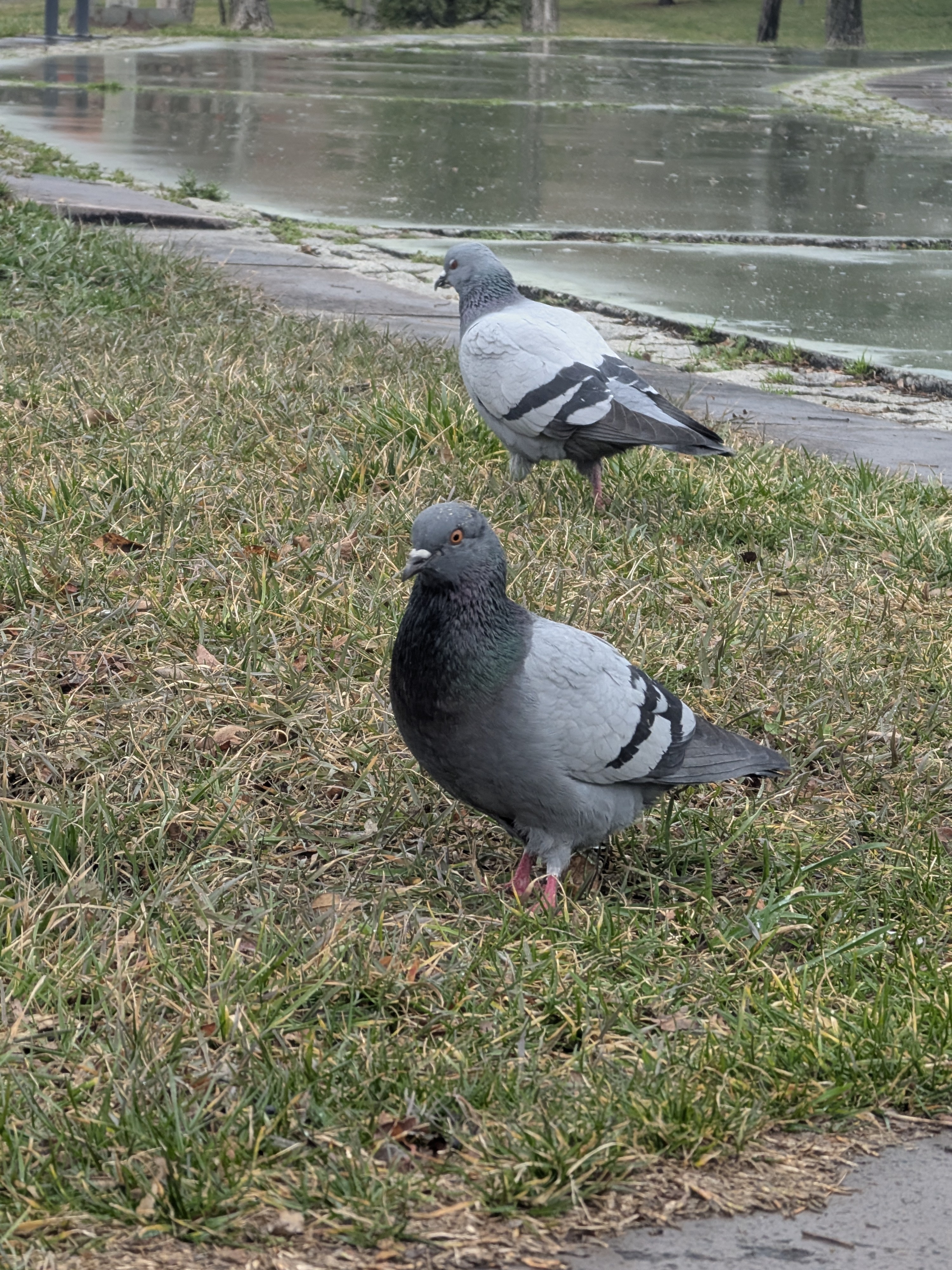
A wild-type Rock Pigeon (Columba livia). Note the iridescent neck feathers and double black wing bars. Image: Wikimedia Commons, CC BY-SA 3.0
---
Vocalizations
The sound of the pigeon is the soundtrack of the city, a soft, rolling coo that often goes unnoticed in the urban din. But listen closely, and you hear the language of a survivor.
Featured Recordings from XenoCanto
Display and Song:
Recording by Stanislas Wroza - The familiar "Coo-ROO-coo" of a male displaying with wing claps.
Call:
Recording by Patrik Åberg - Vocalizations of Columba livia.
Browse all *Columba livia* recordings on XenoCanto →
---
The Scientific Account
Taxonomy and Origins
Scientific Name: Columba livia (Gmelin, 1789)
Common Names: Rock Pigeon, Rock Dove, Feral Pigeon
Family: Columbidae
The humble street pigeon is actually the Rock Dove, a cliff-dwelling species native to Europe, North Africa, and South Asia. Our urban pigeons are feral descendants of domesticated birds—escapees who found that concrete skyscrapers make excellent substitutes for sea cliffs.
The Navigator's Brain
The pigeon's ability to find its way home is one of nature's great marvels. A homing pigeon released 1,000 kilometers from its loft, in a place it has never been, will circle once and then fly straight home. How?
Science is still unraveling the mystery, but we know they use a multi-layered navigation system:
1. Magnetoreception: Pigeons have cryptochromes in their retinas that allow them to "see" the Earth's magnetic field. They also have magnetite-based receptors in their beaks (though this is debated) that sense magnetic intensity.
2. Sun Compass: They use the position of the sun and their internal clock to determine direction.
3. Olfactory Map: Surprisingly, smell plays a huge role. Pigeons build an "olfactory map" of their surroundings, associating wind-borne odors with directions.
4. Visual Landmarks: As they get closer to home, they switch to recognizing highways, rivers, and buildings.
Milk for the Young
Pigeons are among the few birds that produce "crop milk"—a nutrient-rich secretion from the lining of the crop. Both male and female pigeons produce this substance, which is higher in protein and fat than cow's milk. This allows them to breed nearly year-round, as they are not dependent on insect availability to feed their young.
---
The Sacred Symbol: The Holy Ghost
In the eyes of faith, the Columba is far more than a biological navigator; it is the physical manifestation of the Spirit.
The Descent:
All four Gospels record that at the baptism of Jesus in the Jordan River, the Holy Spirit descended upon Him "like a dove" (hōsei peristeran). This moment cemented the bird as the eternal symbol of the Holy Ghost—the third person of the Trinity. In Christian art, a descending white dove with a three-rayed nimbus is the universal depiction of the Spirit entering the human realm.
The Offering of the Poor:
The connection between the Messiah and the bird began at his birth. When Jesus was presented at the Temple, his parents—Mary and Joseph—offered "a pair of turtledoves, or two young pigeons" (Luke 2:24). This was the sacrifice prescribed in Leviticus for those too poor to afford a lamb. The Savior was redeemed with the humblest of birds, establishing a bond between the Divine and the pigeon that represents purity, simplicity, and God's accessibility to the poor.
"Harmless as Doves":
Jesus invoked the bird's nature in his instruction to the disciples: "Behold, I send you forth as sheep in the midst of wolves: be ye therefore wise as serpents, and harmless as doves" (Matthew 10:16). He recognized in them a quality of innocence (akeraios—unmixed, pure) that he desired for his followers. He loved them not for their strength, but for their singular focus and lack of guile.
---
The Captain's Account
The Unsung Hero
The Captain has no patience for those who call them "rats with wings." To the Captain, the pigeon is The Messenger.
Long before the telegraph, the radio, or the internet, there was the pigeon.
- The Ancient Egyptians used them to announce the flooding of the Nile.
- The Greeks used them to send the names of Olympic victors to their home cities.
- Genghis Khan established a pigeon post system across Asia.
- The Rothschilds allegedly built their banking fortune on news carried by pigeons (though the Waterloo story is likely a myth, their use of pigeons is fact).
During the Siege of Paris in 1870, when the city was cut off by Prussians, pigeons carried thousands of microfilmed messages out of the city. In World War I and II, pigeons like Cher Ami and G.I. Joe) saved thousands of soldiers' lives and were awarded medals for bravery.
The Message to Galatia
The Crew tells the Captain that they found him because of a pigeon.
While the Captain was wandering the ruins of Ancyra, lost in thought about the Galatians, a grey bird with an iridescent neck landed on the head of a statue of Augustus. It looked at the Captain with a bright orange eye, cooed once—a low, rolling sound that echoed off the marble—and then took flight, circling three times before heading due west.
The Captain followed.
He did not know it then, but he was following the oldest GPS in the world. The bird led him not to a place, but to a realization: You cannot be a captain without a ship, and you cannot be a ship without a direction.
The pigeon knows where home is. It does not guess. It does not debate. It feels the magnetic pull of the earth in its very bones, and it flies.
Lessons from the Coop
1. Home is a Magnetic Force: You don't find home by looking at a map. You find it by feeling the pull.
2. Grit Matters: Pigeons thrive in our dirtiest cities, eating our trash, nesting on our air conditioners. They are the ultimate survivors. They do not ask for pristine wilderness; they make the world work for them.
3. Speed is Deceptive: A pigeon looks clunky when walking, bobbing its head. In the air, it is a missile. Racing pigeons have been clocked at over 140 km/h (90 mph). Never judge a sailor by how he walks on land.
---
References
Wiltschko, R., & Wiltschko, W. (2019). Magnetoreception in birds. Journal of Royal Society Interface. PubMed
Gagliardo, A. (2013). Forty years of olfactory navigation in birds. Journal of Experimental Biology. JEB
Jerolmack, C. (2013). The Global Pigeon. University of Chicago Press.
---
Part of the Captain's Avian Studies - Where Ornithology Meets the Open Sea
"Trust the bird. He knows the way better than you do." - The Black Captain